
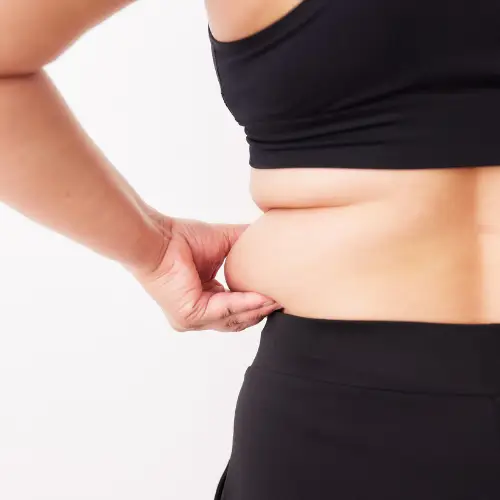

Stubborn body fat is one of the most frustrating issues you can come across as a woman over 40 years of age. We’ve all had those “problem areas” that bother us when we look in the mirror. Those areas you try to hide with your outfit choices on a night out. Sometimes these areas can bother you so much you avoid going out altogether, as you just don’t feel comfortable or confident.
I get it. I know it’s an awful feeling. And while I’m all for body positivity and self-acceptance, the reality is you want to feel comfortable in your own skin. It’s not about anyone else’s opinion, it’s about how you feel in yourself.
With that in mind, in this article we’re going to tackle the thorny subject of stubborn body fat. My hope is that by the end of this piece, you’ll have moved just that little bit further away from the yo-yo, fad diet mentality, and be a little more educated and confident in your approach to changing how your body looks, feels and moves.
The Stubborn Areas
Most women struggle with similar areas when it comes to stubborn body fat. Not everyone is the same, and some women have different issues than others, but for most women, there’s a predictable pattern. The “problem areas” for women tend to be in the hips, thighs, lower belly, backs of the arms, and on the bum. If your stubborn area is on this list, you’re in good company. But either way, rest assured that your stubborn areas aren’t a result of anything you’re doing wrong. The distribution of body fat is predominantly genetically determined (although there is some evidence suggesting a decline in oestrogen during menopause contributes to abdominal fat storage). This, however, still leaves us with the problem of how to deal with it.
Targeted Body Fat Reduction?
The logical place to start when thinking about reducing an area of body fat would be to work that area in the gym a little more, right? That’s the first line of thinking that occurs to most women when they start trying to address a stubborn area. Although this makes sense at first glance, when we look a little deeper, we begin to understand that it really doesn’t work.
From a body composition perspective, there’s only really two types of tissue we’re interested in: muscle and body fat. The way we change the body is by increasing muscle tissue and decreasing fat tissue. This is how we start to mould our body into a different shape.
Unfortunately, these two tissue types behave quite differently. We can grow muscle tissue through targeted work in the gym. If we want a firmer set of thighs – we can work them under load and over time, we’ll see a difference in the muscle. Muscle responds – and grows – to a stimulus in the gym. Body fat isn’t so kind to us.
We can think of body fat as stored energy. If we have a surplus of calories that aren’t needed to fuel the body, we store the extra as body fat, like a squirrel storing nuts for the winter. Ancestrally, this was an enormous advantage for our species. It allowed us to go long periods of time when food was scarce without starving to death. The storage of body fat is an incredibly intelligent evolutionary answer to the problem of long winters without much to eat.
However, in the modern world, those long, scarce winters never really arrive. Sure, we go through the same seasons, but the embarrassing abundance of resources we’re all beneficiaries of mean that instead of using up our stored energy each year, we simply keep adding to it. Winter for the modern human is a period of higher consumption than our distant ancestors could have ever dreamed of, even though we share the exact same biological makeup.
Considering fat as stored energy, then, helps us to understand that we can’t simply crack open a pot of energy from a particular part of our body and use it. Unfortunately, the body will take the energy from wherever it darn well pleases, and again, this is genetically determined.
We can’t choose where the fat comes off first. In the gym we can work and stimulate muscle tissue, but we can’t directly tap into fat stores. If it were the case we could choose where we lose body fat, we’d simply have everyone doing endless amounts of sit-ups to lose belly fat. How simple fitness would be if it were this easy!
A Better Way
Before you give up all hope after this rather gloomy start to the article, I’d like to present a better, more scientific and effective approach to losing body fat as a woman over 40. This is a multifactorial approach that will discuss the principles involved in losing fat. It’s not new, it’s not sexy, and it’s unlikely to make the cover of any magazine. But it has an advantage that the photoshopping, AI generated BS models of the world lack – it works.
The Metabolic Supercharge
Earlier, we spoke about how weight training can only work muscle, not directly target body fat. And that’s true, we can’t directly target body fat through our movements. But that doesn’t make indirectly targeting it impossible or ineffective.
Working our muscles in the gym isn’t simply an attempt to make you a female Arnold Schwarzzenegger. You lack anywhere near the appropriate amount of male hormones to bulk up or look masculine. But growing a little bit of muscle not only helps the shape of your body, but it has a much deeper and more important effect – it supercharges your metabolism.
Growing muscle tissue demands a growing supply of blood flow, of oxygen, of nutrients and of everything muscle tissue needs for survival. This delivery of extra resources costs energy, in a similar way that you’d use more petrol to move a heavier car. The extra energy expenditure in real terms is a higher number of calories you’re burning through every day, simply to supply your muscle tissue. This is a very real way to improve your daily calorie output, make weight loss easier, and supercharge your metabolism.
Sure, we still can’t pick which part of the body we lose fat from first, but by having regular weight training as the foundation of our health and fitness routine, we can move forward with a massive headstart on anything we’ve tried before.
Something Pretty NEAT
Once we’ve cemented weight training as the foundation of our exercise and fat loss strategy, the next piece of the puzzle is to increase what’s known as our “Non-Exercise Activity Thermogenesis” – or NEAT for short. In English, this means all the energy we burn off that isn’t directly related to a structured exercise session.
This may seem negligible or even a tad ridiculous, but the data we have on this might surprise you. For example, did you know that people who fidget a lot have been shown to burn 38% more calories when standing than those who stay still? This isn’t an advertisement for fidgeting, but if something so forgettable and small can make such a monumental impact on your results, maybe it’s worth paying attention to.
To make this real and measurable, the best place to start is with your daily step count. Increasing your step count marginally more than you’re used to could be the boost in calorie expenditure you need to start seeing that extra bit of body fat begin to shrink. Unlike many fitness professionals, I won’t be recommending you aim for a certain number of steps per day. I happen to think the number is arbitrary if applied to everyone regardless of context or circumstance. However, a good rule of thumb is to track your usual step count for a few days, then add 1000 to whatever number your average is as your new goal. So if you naturally walk 3000 steps per day without trying, an extra 1000 shouldn’t be too far away from your comfort zone to make it impossible to fit in with your life. For context, 1000 steps is about 10 minutes of normal-paced walking. I think you’re capable of that.
What I usually recommend at this point is to monitor your body weight or body image and see how things go for a week or so. If you’re not seeing the changes you’d like, increase your steps by a further 1000. Repeat this process until you’re doing the maximum number of steps you’re comfortable with, or until you’re seeing the changes consistently and don’t need to push any harder.
The Nutrition Factor
You knew it was coming. We can’t discuss fat loss without focusing on nutrition. Now, nutrition is such a mammoth topic that even attempting to cover it all in one section of this article would be doing you a massive disservice. We have a lot of other articles on this website covering all different aspects of nutrition, and our over 40s ladies group has a step-by-step system for beginners to get up to speed with the basics of nutrition. For now, here’s a few pointers to get you started with an effective nutritional protocol for sustainable fat loss:
- Set a defined eating and fasting window (have a maximum of 12 hour per day eating and a minimum of 12 hours fasting per 24-hour period)
- Define the times of day you’ll be eating and make sure these are sustainable around your existing commitments
- Make sure each meal contains a minimum of 30-40g protein for muscle growth and recovery (to help fuel those metabolic benefits we discussed earlier)
- Limit your carbohydrate intake and base your diet around healthy animal fats as much as possible
The scope of this article isn’t wide enough to provide more details on nutrition than this, but we’ll cover more on each point in future articles.
In Summary
In this article we’ve gone through a little about the common misconception that you can “spot-reduce” body fat from certain areas of the body. Hopefully by now you understand that this isn’t possible, but you are armed with a little more information about how to structure your approach in a way that works for sustainable fat loss.
Please note that this article is not meant to be an exhaustive guide to fat loss. There are several incredibly important factors that I’ve left out of this piece for the sake of keeping your attention and not waffling on for hours. But the points I’ve made are hopefully enough for you to make some effective and targeted tweaks to your fat loss strategy.
If you need some more personalised help with your health and body image goals, we have a small group personal training programme based on Wheatley Hall Road in Doncaster specifically for ladies over the age of 40. If you think it could be the right thing for you, check out all the details by clicking the limk below:
Thanks for reading
Andy Clements
Head Coach and Owner
DC Personal Training